

The King on Saturday [November 23th, 1918] conferred 280 decorations at an investiture at Buckingham Palace, and among the recipients were Dr Bell (Military Cross), of Luton, and Capt Paul Ward Spencer Bulman, R.A.F. (son of the Vicar of St Paul's, the Rev Thomas Bulman), who received the Air Force Cross.
Of all the splendid local war records, none shines more splendidly than Capt Bulman's. Although a very young man, Capt Bulman has since the end of 1917 been promoted from Second Lieutenant to Captain, gained the Military Cross three times and been awarded the Air Force Cross. The latest decoration is for extraordinarily good flying in England. After doing more than his bit in France he has for some time been in command of a squadron at Shotwick, near Chester, and had not had an accident, a fact which speaks well for his skill as a pilot.
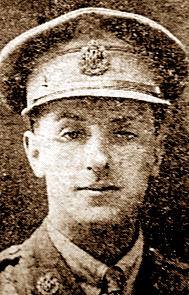 Capt Bulman (pictured right) is becomingly reticent on the subject of his courage which gained him his honours. We, at any rate, know that on one occasion while he was in the air the propeller of his aeroplane was shot away, and that he still went on into safety. It is interesting to know that part of that propeller afterwards stood on the mantelboard of a room in his father's house. It was made into a beautiful photograph frame by Capt Bulman's fitter with a penknife, and became a fitting holder of his captain's portrait.
Capt Buloman is the elder son of the Vicar of St Paul's, and left the Bank of England for the Honourable Artillery Corps. He joined with a friend who unfortunately lost a leg. Capt Bulman was subsequently transferred to the R.A.F. And did good work in France. He has just been home on leave.
When he gained his second Military Cross, his major wrote: “It is with the greatest possible pleasure I write to inform you the great news came through that your son has been awarded a bar to his Military Cross. He has more than earned it by splendid work, especially during the recent operations.”
As recorder in the [London] Gazette, the work for which Capt Bulman was honoured the second time was: “On four successive days when on low bombing patrol, out of a total of 16 bombs dropped on enemy troops and transports, he obtained eight direct hits and seven others within ten yards of the objective, inflicting the most severe casualties on the enemy.”
The Vicar has another son with the forces who joined the Royal Fusiliers in the first November of the war, and in July 1916 was shot through the chest in the battle of Pozieres. He recovered and was gazetted as lieutenant, being transferred to the Beds Regiment. He became a physical drill officer, and is now attached to the R.A.F.
[The Luton News: Thursday, November 28th, 1918]