

Stories from The Luton News: Thursday, November 25th, 1915.
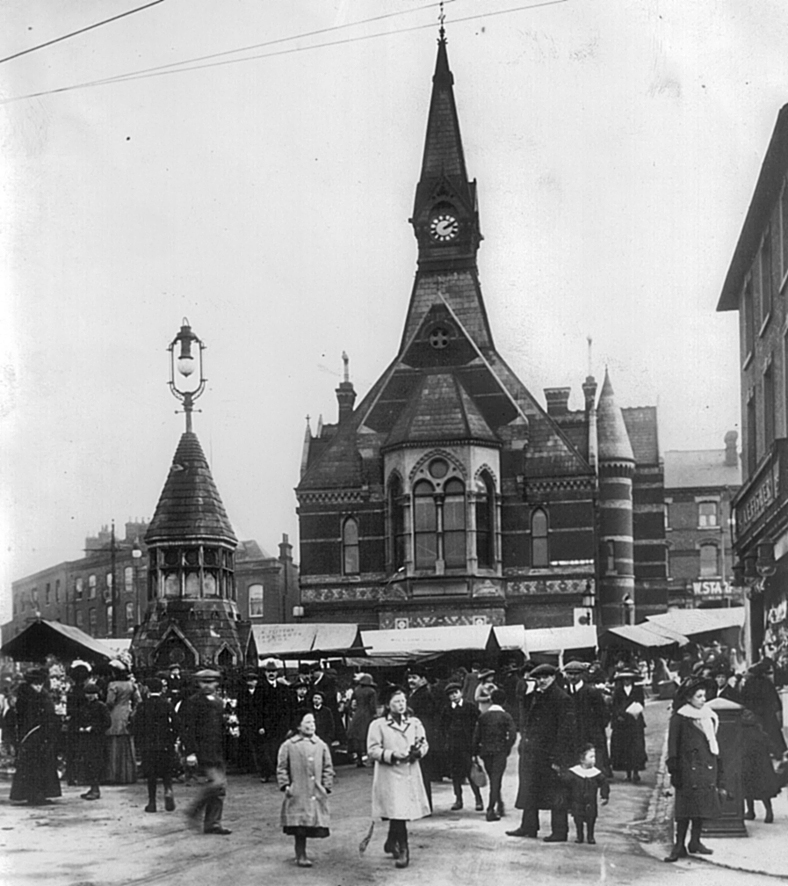
The greatly extended work of the recruiting authorities at the Luton Corn Exchange has resulted in the Luton Corn Market being transferred to the Town Hall for the time being.
So much of the space at the Corn Exchange is required by the recruiting staff, and so much more than was contemplated when the Town Council gave the recruiting authorities the use of the building as a recruiting centre, that the position was reached on Monday when the farmers and corn merchants found themselves unable to carry on business.
The Town Clerk was called on by Councillors Dillingham and Rainbow at 3.30 and informed of the trouble which was experienced by the farmers and corn dealers, who were getting a bit excited because they could not carry on business. He was asked to go to the Corn Exchange, and found that at least half of the building was occupied by the recruiting staff, who were very busily occupied in dealing with recruits and possible recruits.
It was found by the Town Clerk that it really was impracticable to carry on the corn trade, and also impracticable to arrange for the recruiting work to be transferred elsewhere on the occasions of the Monday Corn Market.
He was authorised by the Chairman of the Tolls Committee to offer to the corn trade the use of the Assembly Room at the Town Hall. Only two persons expressed any objection to the proposed transfer. The Corn Market will therefore be held at the Town Hall for the time being.
[Corn Exchange picture: February 1913]
-
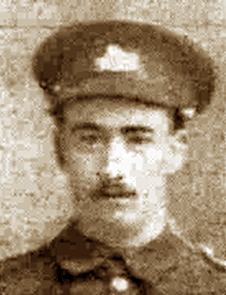 Pte Harry Stanley Smith (pictured right), 3228, 1/5th Battalion, Lincs Regiment, has received the Croix de Guerre from France. The gallant soldier, whose home is at 164 Leagrave Road, Luton, is lying in the Woburn Abbey Hospital having been wounded for a third time. He is the son of Mrs Tooke and is not yet 23 years of age.
 -
One of the technical representatives of the Skefko Ball Bearing Co Ltd, Leagrave Road, Luton, who enlisted in the ranks and obtained a commission has now been awarded the Military Cross. Temporary Second Lieut Joseph Wilson (pictured), 6th Battalion Queen's Own Cameron Highlanders, received his decoration for conspicuous gallantry on Hill 70 on September 26th, 1915. He collected and rallied stragglers and led them through troops of another Division who were retiring and remained in the most advanced position, where they hung on during the night.
-
Sapper Percy Langridge, son of Mr and Mrs F. Langridge, 59 Ramridge Road, Luton, who was severely wounded while serving with the East Anglian Divisional Engineers in Gallipoli, is now recuperating at home. He had first been reported killed but news that he was alive and in hospital came very soon afterwards. His injuries were on the left side and included a compound fracture of the left arm, a terrible gash on the muscles of the same limb, a shrapnel wound clean through the throat, and also in the left leg. He reported to the Depot at Bedford yesterday, but it is extremely doubtful he will ever be fit for further service.
-
A severe accident befell James Pate, of 31 Brache Street, Luton, on Monday afternoon. He was working for Mr Abrahams, dyer, of High Town, and about 3.30 he was cleaning the wringer, which was in motion. The machinery caught the rag he was using and he tried to snatch it out, and his hand was caught. His arm was terribly lacerated and he is now an in-patient at the Bute Hospital.
-
Among the French Honours conferred on the British Air Service is the Cross of Chevalier of the Legion of Honour (conferred by the President of the French Republic) to Capt James Valentine, Royal Flying Corps. He is a nephew of Mr William Austin, of Rye Hill, Luton, and flew over Luton in the great air race over four years ago.
-
Mrs Soper, of 81 Boyle Street, Luton, has received a letter from her son, Cpl W. Soper, 1/5th Bedfords, who is in hospital in Cairo suffering with dysentery. Prior to being called to the Colours, he worked at the Diamond Foundry.
-
A serious accident befell Mr A. C. Wren, of 55 Collingdon Street, Luton on Sunday evening. He was examining the ejector of a gun which he had just put in order and had placed a cartridge in the gun, which suddenly went off. His left hand was injured at close range and he now a patient at the Bute Hospital.
-
Chief Constable Teale informed the magistrates at the Luton Borough Court on Monday, when three soldiers were before the Bench for being drunk and disorderly, that the Colonel at the Artillery School [Biscot] had sent a message asking that an example should be made of offenders, as some of them were getting out of hand. The cases arose out of a disturbance outside the Queen's Head public house in Chapel Street on Saturday night and all three were fined, with an alternative of a week (two cases) or 14 days (one case) imprisonment. The court had heard that civilians were beginning to think that soldiers were getting out of hand, and on Sunday night there had been complaints that several soldiers were molesting girls.
-
Two further accidents involving trams were reported. On Friday morning, a collision occurred in Dunstable Road between a dray owned by Messrs G, Powdrill and Sons, and a tram in which barrels loaded on the dray went rolling down the street. The following morning, an elderly woman from Queen Street was knocked down by a tramcar in Park Street and received bad cuts to the head.
-
Two further special requests from men serving at the Front. Pte H. A. Saunders, 10280, A Company, 1st Beds Regt, appealed for boxing gloves so that he and his comrades could pleasantly pass their night is the rest billets after 15 months in the trenches. And former Queen Square schoolboy Pte L. Parsons, of the Grenadier Company, 6th Bedfords, with the British Expeditionary Force, appealed for mouth-organs for himself and fellow bomb-throwers.
-
In time-honoured custom, the new Mayor of Luton (Alderman J. H. Staddon) attended divine service in state on Sunday. The civic visit was paid this year to the Waller Street Wesleyan Church, with which Alderman Staddon is associated.
-
George Kent Ltd placed a large advert for billets the firm was anxious to find in the neighbourhood of the Biscot Road works for 200 or 300 munition girls.