

The reopening of the Group System today [January 10th, 1916] gives another chance to the young men who failed to come up under Lord Derby's scheme to show that it was not for want of patriotism or courage that they did not answer the country's call. Those who did not take advantage of it may prepared for the alternative of compulsory military service, imposed by a new Bill now passing through Parliament, under which they will be deemed to have enlisted for the duration of the war four weeks after the Bill becomes law.
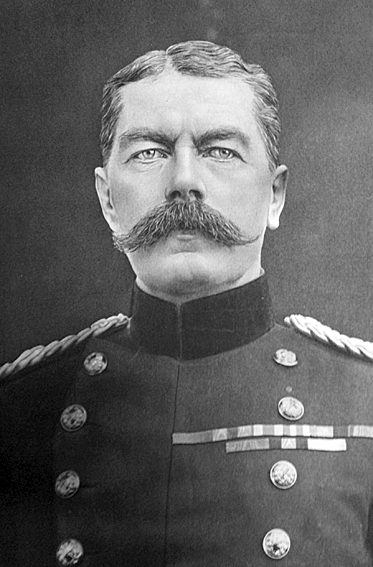
This new measure introducing compulsory military service has been much criticised in some quarters, but unquestionably the vast majority of the people are convinced that it is fully justified by the dictates of patriotism and common sense. It is required by the urgency of the war needs of our Army for, as Lord Kitchener [pictured] has declared, "the existing system (of voluntary enlistment) is not equal to maintaining the Army which is needed to secure victory". It is also required to redeem the pledge given by the Prime Minister that the married men who had signified their willingness to serve their country under the Derby Scheme would not be called away from their homes and families till the unmarried men had shouldered their fair share of the nation's burden.
 The results of the great recruiting rally under the Derby Scheme have shown that there is a large residue of unmarried men who have not come forward to give the service which is due from them.
Various ingenious means of minimising the number have been devised by opponents of the Bill, but the number remains too refractory for their purpose; it cannot be made to appear "negligible," and at the lowest computation which is not obviously absurd it exceeds that of the men of the original British Expeditionary Force who changed the whole course of the war by their valour in the battle of the Marne.
Our own town has given a splendid answer to the call in the number of men who have voluntarily joined the forces since the outbreak of the war, and figures which are published for the first time today prove that in the South Bedfordshire recruiting area, of which Luton is the chief centre, the number of single men not engaged in war work or in what have been declared indispensable occupations who have failed to "toe the line" is not by any means to be regarded as "negligible".
There are, or were when the Derby canvass was opened last November, 13,449 men of military age to whom the appeal for enlistment was made, and more than half of them it now appears ignored the appeal. At any rate they did not present themselves at the recruiting offices.
It is true that 3,849 were engaged in what is known as "starred" occupations. Although they were not required for the Army, they were specially asked to attest, but 2,500 of them did not take the trouble to do so. Yet, if we leave these out of account, we find that there were 9,600 men who were not engaged in reserved occupations and who might have been expected to offer themselves for enlistment, and not half of them came forward. The actual number attested was 3,708, of whom 2,462 were married and 1,246 single.
It is rather surprising to learn that out of 6,649 men who presented themselves, three were rejected for every four passed!
But the most unsatisfactory feature of the returns is to be found in the failure of the single men between 19 and 28 years of age to respond to the call. They came up rather better in the older groups for single men, but generally speaking they were a long way behind the married men. As a matter of fact the returns all point to the young married men coming up on the Prime Minister's pledge, and of the young single men hanging back. It is actually the case that the number of abstentions among the first ten groups of single men is just about double the number in the first ten groups of married men.
This is just what seems to have happened throughout the country and, under the circumstances, it was inevitable that Parliament should proceed to take steps to bring in the single men who were holding aloof.
No one can fairly say that the Bill which had been presented to Parliament is a harsh or extreme measure. It necessarily makes military service an obligation, but it is generous in its exemptions. Military service is not required from men employed in essential national work; men who are the sole support of dependents; men physically unfit; and those who conscientiously object to combatant service - but in the last case the exemption is "from combatant military duty only". This limitation carries its own justification.
There are many who think the Bill does not go far enough, but its opponents manifestly fall into two classes - those who have grasped the true gravity of our position in this war, and those who apparently do not wish to see Germany defeated. The first class is still swayed by its normal bias in political controversy, and does not perceive that an attitude adapted to times of peace is a menace and danger to the whole Empire in times of war such as these.
Of the other class it is hardly necessary to speak. Their protestations of unwillingness to harm their country have never concealed the glaring fact that at every stage of the war and by every means in their power they have done their utmost to hamper and discredit British action.
[The Luton Reporter: Monday, January 10th, 1915]