

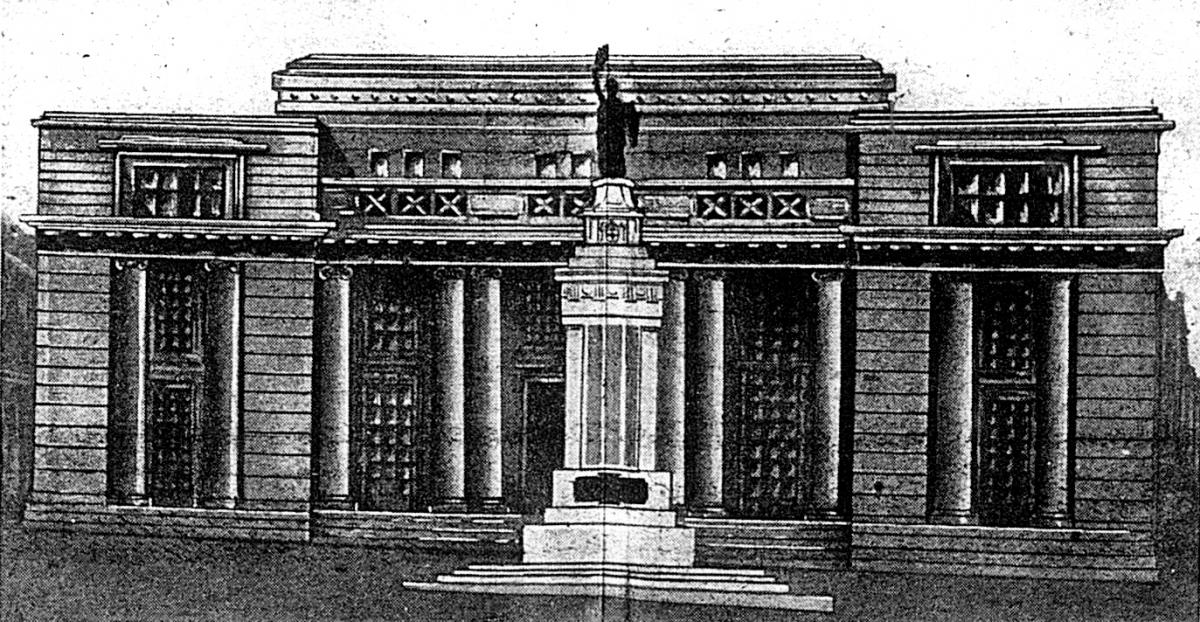
- Architect Basil C. Deacon's vision of a possible new Town Hall with the 1922 war memorial in front.
With the conclusion of the war and so many Luton lives among those sacrificed, the question of a war memorial immediately arose in the correspondence columns of the Luton News.
In the November 21st, 1918, edition, J.R.M. wrote: “Many towns are now taking steps to raise a war memorial. Cannot Luton do the same? Its large industries have prospered largely in producing war material and could surely raise forty or fifty thousand pounds for this purpose.
“What more fitting than a new Town Hall? The town needs it badly. It has the land and nothing would help more to beautify the town than a fine building where the present out-of-date building stands.
“The clock in the present building was placed there to commemorate the peace after the Crimean War in 1856. Why not commemorate this glorious peace in raising a building of which the town should be proud.”
The idea did not find approval from Dr Horace Sworder, who the following week wrote: I do not agree with the suggestion [of a Peace Memorial Town Hall], but that by the way. I hold strongly that whatever Peace Memorial we may later determine upon, our first thoughts ought to be concentrated upon the raising of a memorial not unworthy of our gallant dead. Luton has done well in sending quite her share of men to the front.
“Week by week we have had to mourn the deaths of those who 'counted not their lives dear unto them,' but nobly gave them up to save us, their brethren, from untold horrors, ignominy and slavery of the worst description. The Huns deemed themselves, and were described as super-men. One had only to read the enumeration of those who received honours from our King to discover that most of them performed deeds of daring which seemed to be almost humanly impossible, and without boastfulness, showed on which side super-men were to be found.
“It is not boasting so to say, for know that these acts of our race were only in fulfilment of prophesy, the hands of our men being indeed 'made strong by the hands of the mighty God of Jacob'. To read the wonderful doings of our Army and airmen during the last few months, fighting day by day and month by month, never once being beaten, but ever victorious, would have seemed preposterous and incredible if written as fiction, but nevertheless perfectly true. To God be all the praise! May we not say with the Psalmist who has so well and nobly expressed our thoughts and feelings these four years past: 'But Thy right hand and Thy arm, and the light of Thy countenance, because Thou hadst a favour unto them'.
“Our Navy and Merchant Service, and airmen, under God we know, made these victories possible, for without the glorious and ever sustained night and day services of our 'Sure Shield' we should have been starved into submission and not one American soldier could have reached the battle front.
“Does it not behove us one and all to set our wits to work to suggest a fitting memorial for such inestimable service. In raising it to our noble dead, we shall at the same time honour the living, and help to show our own quality.”
“Finally, I will gladly give £10 to any individual whose suggestion may be ultimately adopted, or, if preferred, will have the money over to the Town Clerk to devote to some good 'war' object approved by the three of us.”
But 'Gassed' had a different idea. He wrote: “If the correspondent who suggests a new Town Hall for Luton as a war memorial at a cost of forty or fifty thousand pounds means that the money should be given to the town by those industries that have prospered over war materials, well and good; not otherwise. There is not possible chance of the war being forgotten even without a 'storied urn,' for if the Hun do not pay our expenses over it we shall be taxed for one hundred years to pay the debt.
“The most sensible war memorial Luton could invest in is an effective sewage disposal system. The present arrangement of tanks and machinery to stir their contents only proves the adage that ' there are some things the more they are stirred the more they stink'. A good many of the residents of the East Ward and Hart Hill can vouch for the nauseating effluvia that pervades their homes frequently in the small hours of the early morning, and the daytime too, from our sewage.
“Buy the trimmings and then see what is left for the garment, if there is any left. This sewage disposal necessity will have to be tackled in the near future, and instead of fizzling money away on ornaments, let us make the town more habitable and sweet by pumping the sewage right away to a distance. This would make a memorable event – the riddance of the Hun and our sewage.”