


Congratulations to Mr David Teale, who has completed 21 years service as Chief Constable of the Borough of Luton. Mr Teale came to Luton on September 26th, 1894, to succeed Chief Constable Jaquest, but it was on October 1st that he actually took up his new duties.
He came from Burnley, where he was an inspector, and as he then had 17 years practical police experience to his credit he now has a record of 38 years service. He might have retired on pension some time ago, but prefers to remain in harness while his health permits.
In the 21 years which have elapsed since Chief Constable Teale (pictured below) came to Luton there have been many changes. At that time the population was something just over 30,000 - today it is estimated at 56,000. The police force then numbered 30 officers; the present strength would be 55 but for the fact that some who were reservists were recalled to their regiments when war broke out, and others have since been temporarily released for war service.
Farms which existed on the edge of the town 21 years ago have since given place to street after street of houses, new industries have come and old industries developed, and in every way there has been progress.
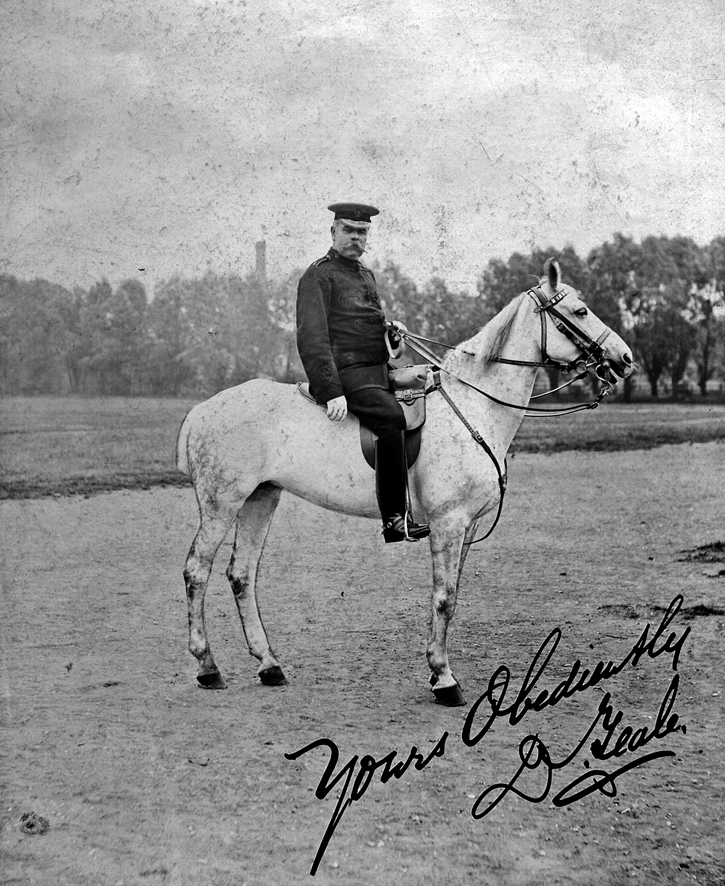 Commenting on this growth when interviewed by one of our representatives, the Chief said he had always been gratified to find that the town to which he came was one of progress, and with some life in it, instead of an outlandish place almost too slow even to die.
It is interesting to compare the size of the town as we know it today with its condition in 1894, for this affords a very good indication of the extent to which the ordinary patrol work of the police has increased for the police department. Perhaps it is only a lesser cause, for a very great cause is to be found in legislation, and especially that of recent years, its tendency being to throw more and more work on the police.
In 1894 there was not a house on the left-hand side of Dunstable Road beyond the Union House with the exception of a small row of cottages, since converted into shops, beyond what is now Kenilworth Road.
On the Downs Mr Arthur Bird's house was the only one, and outside of a line from Mr Bird's house to the Midland Railway arch in Leagrave Road building development had not begun.
In Biscot Road there was only the house occupied by Mr Middle, and Messrs Durler and Sons' bleach works. Whitby Road, Curzon Road etc did not exist, to say nothing of the many streets which have now sprung up between Messrs Kent's works and the [Biscot] windmill. It is, in fact, not much more than a decade since the late Mr Joseph Chamberlain addressed a huge meeting from a platform erected on a spot of ground forming part of what is now Lansdowne Road.
Along Old Bedford Road the town did not extend father than North Street, and the people who now live in Frederic Street, Reginald Street, Clarendon Road and other streets in that neighbourhood have their homes and their factories on land which, when Mr Teale came to Luton, was all allotment gardens. Havelock Road was a dirty narrow lane from North Street forward into the Park and Park Way [Kingston Road] was the limit to which development had reached in that direction.
On the other side of High Town Road, Charles Street marked the fringe of the town, while in Hitchin Road, except for property at the foot of the hill which even to the most casual observer shows that it belongs to the earlier order of things, there was one solitary house at the top.
Round Green was just a little country hamlet - one or two public houses, and not even a church which is so often found a near neighbour to the village alehouse. Today it has become quite suburban.
The town pound used to stand in Crawley Green Road, but that was before there were any houses there, and before the roads between Lea Road and the Recreation Ground were laid out, and before the building of Windmill Road had begun. Hart Hill had a few big houses, but not nearly so many as now dot that eminence.
Bailey Hill was open fields, there was nothing beyond the top of Chase Street, and Ashton Road was only partly built, while London Road from White Hill was open country. Further across, Russell Street marked the boundary, the only house above this being St Saviour's Vicarage, built just above the church.
Within Chief Constable Teale's time the Bedfordshire Agricultural Society's show has been held on Beech Hill on land at present covered by the Guardians' home for children, and by the side of the country lane which has now blossomed into Dallow Road there were four houses, somewhere about the point of Brantwood Road.
Farm labourers' cottages further down still exist, as a side road was laid out so that they fronted on to it, but the farmhouse which stood father back from the lane has gone the way of all things. It was occupied at that time by Mr William Ward, who when he retired went to live at Lewsey.
The Bury, which has quite recently been swept away to make room for a number of smaller houses [Bury Park], was then a mansion standing in splendid isolation.
The football ground was in Dunstable Road [Dallow Lane], and on the town side of the Great Northern Railway arch. From there it was moved further down Dunstable Road, opposite the Gas Works, and then again to its present location.
These are some indications of the manner in which Luton has grown in the course of the comparatively short space of 21 years, and few towns could show a similar record. The causes can easily be traced in the development of the existing industries and the introduction of new ones, some of which brought with them big contingents of workers and have since been attracting more and more workers.
The police accommodation at the present time is anything but up-to-date - this is our comment and not the Chief Constable's - but it is considerably better than it was. In Mr Teale's early years in Luton the police were huddled into the little rooms at the Plait Hall, and any prisoners who were arrested had to be taken to the County Police to be taken care of until they could be brought before the Bench. Possession of the present premises was acquired in 1900, and since then Mr Teale has lived on the spot, instead of in Crescent Road.
It seems strange now to think that at the time Luton had no place of public entertainment. A theatre, if thought of, had not materialised, but sometimes strolling players visited the Town Hall. But they never stayed more than three nights, says the Chief Constable.
It also seems strange to be now told that in his early years here girls thought it quite improper to be out after nine at night, but which time they would all scurry home. "I am afraid their modesty at the present day does not compare with 21 years ago," said the Chief Constable. "You will frequently find them out at eleven and twelve at night without blushing."
For the members of the Force the conditions of service have been improved considerably. The maximum pay of a constable has increased from 29s 2d to 35 shillings; of a sergeant from 33s 3d to 42s; and of inspectors from £115 to £135. Where they used to work seven days a week they now work only six.
Not many of the 30 or 21 years ago still remain in the service, however. Some are living in honourable retirement on pension, others have answered the final call. The originals, is we may so call them, are Inspectors Hagley and F. Janes, Det Insp Attwood and Sgt Fred Smith.
While Chief Constable Teale's work in connection with the policing of the town has been excellent, he has also done signal service in connection with the establishment of the Police Aid Fund. This was inaugurated about a year after he came, and under its auspices a most beneficent work has been carried on, particularly among the necessitous children of the town. The work of the Fund calls for considerable amount of honorary labour on the part of the members of the Force, but its results are so good that it is sincerely to be hoped that the many other appeals to the charitable which are being made will not prejudicially affect the appeal annually made for this fund.
As to his relations with the people of Luton, Chief Constable Teale says: "I came a complete stranger and many people, I believe, looked upon me with a certain amount of suspicion. But in time that disappeared, and it has been a very happy for me all along. Luton is the town of my adoption, and even if I was retiring from the service I don't think I should leave the town."
[The Luton News: Thursday, September 30th, 1915]