

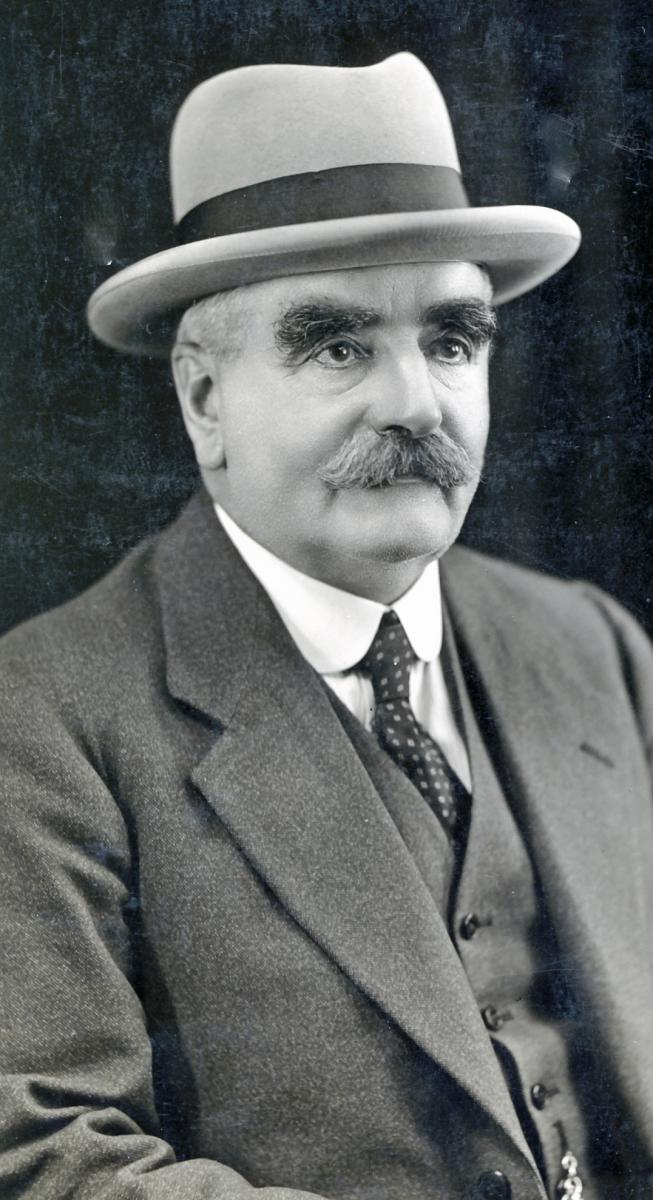
With a view to its submission to the military authorities, evidence was taken at the Luton Borough Tribunal on Thursday evening [August 3rd, 1916] with respect to a case which the Mayor, Alderman J. H. Staddon (picture by Frederick Thurston), described as a scandal.
It concerned an ex-tramway motorman - married to a "war widow" with one child, whose previous husband was killed at Hill 60 - who walked into the Council Chamber with a very pronounced limp, which he assured the Tribunal was "not more so than usual".
 His story was that four years ago he tried to get into the regular army, and the recruiting sergeant "would not look at him" because of varicose veins in both legs and a single rupture. Six years ago he was operated upon in Norwich Hospital for varicose veins, and four years ago he underwent two operations for rupture and was asked to undergo a third but declined.
In addition to these defects he suffers very much from muscular rheumatism, and yet when he went before the Medical Board at Bedford he was passed for general service.
Asked if he told the doctor at Bedford what he had suffered from, he replied that he was not given a chance to say much. The doctor simply examined his chest and then told the clerk to put down, "slight varicoele in both legs, wearing a truss and suspensory bandage, bad mouth - general service."
Members of the Tribunal simply roared with merriment when they heard the man's account, but the Mayor remarked that there was a serious side to it, and asked that a note should be made of the man's story.
Applicant was carefully question by the Town Clerk (Mr William Smith), and he said he went before only one doctor, to whom he showed the varicose veins and the fact that he was wearing a truss.. He had taken off his suspensory bandage before he went into the room, and of this he informed the doctor. He also told the doctor about the operations, and said he was practically a cripple, but the doctor said, "You will do - general service".
The Town Clerk said the man had told him exactly the same story on the tram and showed him scars on his leg where the operations for varicose veins took place. The Mayor said it was a scandal and he hoped they were not going to put up with it as a Tribunal.
Grant of conditional exemption was instantly suggested, but the Deputy Mayor (Councillor J. Primett) said he was not satisfied that the matter should be left there. He thought they ought to present the matter to the officer in charge of the area as a very serious matter indeed, and if they were not satisfied with his answer he thought that in the interests of the man and the country they ought to report it to the War Office.
Mr Harry Arnold inquired if anything had been done yet, and the Mayor replied that he was getting evidence, and this was the strongest they had.
"I think it is a public scandal that a man should be passed for general service in the state this man is in," said the Deputy Mayor, and with a view to bringing the matter to a head it was suggested that conditional exemption should be given on the ground of the man's unfitness.
To this Mr H. O. Williams added the suggestion Mr Gardner (the Military Representative) should appeal so that the case could go before the County Tribunal, and the Lord Lieutenant thus be afforded the opportunity of adding to the weight of criticism.
In the event of this being done, Mr Arnold advocated that the Town Clerk should represent the Tribunal's views of the matter, but the Town Clerk said he was not entitled to appear;it would only be a matter of grace. He could, however, act for the man if the Corporation would allow him to take a private client.
At the same time the Town Clerk suggested that if the matter was going to appeal the Tribunal ought not to put themselves in a false position. This was the case of a voluntary attested man, and there was therefore no provision for granting him conditional exemption on the ground of ill-health, but they could state such a reason for giving temporary exemption.
It was therefore decided to allow that man until December 31st, "the Tribunal not being satisfied that the man is fit for general service for which he has been passed."
[The Luton Reporter: Monday, August 7th, 1916]